
Does a book every founder should read actually exist?
This Friday-> Reviewing a book that covers the most important steps in a founder’s journey. Let’s see what they’ve delivered. [4 min reading]


On Startup Salad, I share key takeaways for founders in a simple and digestible way, just like a good salad!
Hey, it’s Fede!
With Startup Salad 🥗, we’ve talked about dozens and dozens of books.
Masterpieces, good ones, mediocre ones… and a few complete disasters.
But none of them ever had the ambition to create something that could be considered the ultimate founder’s handbook, bringing together everything in one place.
And then came Chris Tottman and other co-authors, with his very own startup manual…
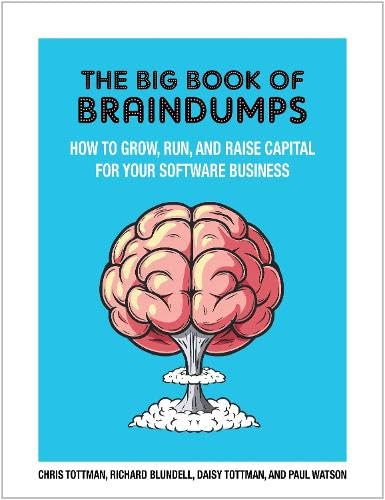
This week’s book is “The Big Book of BrainDumps: How to Grow, Run and Raise Capital for Your Software Business” by Chris Tottman, Richard Blundell, Paul Watson, and Daisy Tottman.
Here’s what the book covers:
How to build a prototype
Which growth model should you use for your startup?
How to define the right metrics to track your performance.
How to find investors and design a solid pitch deck
How to find the right co-founders and manage your team
How to handle go-to-market, acquisition, and retention
And many others…
As you can see, there are so many topics in this book that giving you takeaways for each one would be impossible.
I’d probably end up writing another book.
So today, let’s do things a bit differently.
Let’s start by taking a look at one of the authors behind this project.
Who is Chris Tottman? 🕵️♂️

An entrepreneur? An investor? A content creator?
Instead of doing an investigation, I thought it would be easier to just reach out and ask him a few questions directly.
– Chris, how are you doing? Straight to the point, what did you do before writing this book?
“ I’m unbelievably old at 56, but still full of energy. I co-founded three companies in the last year alone. So think of me as a grey-haired teenager.
Between 1999 and 2008, we built MessageLabs, a messaging security company, from zero to a $150M subscription business before exiting to Symantec. We were adding $2.5M in ARR per month at the time of the exit, making it an incredible experience to build such an extraordinary GTM team.
For the last 17 years, I’ve been building Notion.vc, the European B2B SaaS and AI venture capital firm. We’ve backed more than 500 founders across eight funds. We’re now deploying our €300M Venture Fund V and our €115M Opportunities Fund III, with a combined portfolio generating $1B in ARR. “
– Ok, so you gained some experience and made some good money with startups. But after all that success, what made you want to dedicate your time to this project?
“ I have a lot of mental energy to burn, and it never sits still. I’m still as obsessed as ever with people, go-to-market, flywheels, Price’s Law, outliers, elite mindsets, and the psychology of top founders and operators. This is my second book with Richard and Paul, and my first with Daisy, my daughter, who leads inbound demand for startups at Snowflake. “
– This book has SO MANY authors and collaborations. You’ve got introductions from Guillermo Flor and Ruben Dominguez, and a ton of frameworks from Majd ALAILY. Tell me a bit about the people you worked with.
“ Richard is the main writer for this book and for The GTM Handbook for SaaS Leaders, our first one together. The BrainDumps were originally conceived by Daisy and me over two years ago, when I wanted to share infographics on LinkedIn. I like taking the complexity out of business challenges and turning them into something simple and useful, and that’s how the BrainDumps were born. We now have over 200 of them circulating online, generating around 20 million impressions per year on LinkedIn alone.
When Richard wanted to write our second book, the BrainDumps were the obvious choice. We developed 70 situational stories based on real-world challenges we’ve faced and overcome, giving readers an honest, practical view of each problem, the possible options, and the solution.
We expect readers to make notes in the book and come back to it again and again. Every week, we get calls from founders who are stuck on something and can’t quite figure it out. Often it’s fundraising pitches and we love those moments. That’s what makes it worthwhile: when a founder gets unstuck, refines their approach, and suddenly 80% of their pitches turn into a “yes” instead of a long “no.”
That’s priceless. “
Nice, so the idea and the authors behind it are clear now. The question is: from the idea to the result, how did the execution go? Let’s take a look.
How the book is structured 📚
The heart, or better said, the HEARTS, of the book are the summary graphics for each topic it covers.
Like this one:

So, picture this…
You’ve got a visual like the one above, turning a huge, complex concept into something you can visualize instantly.
Then for each one, the book goes deeper, breaking down the details with clear explanations and tons of useful insights from the authors’ experience.
As someone with dyslexia, I’ve got to say, this format really helps things stick.
Well done with this concept, seriously.
What I personally found most interesting 📈
I believe this book can be interesting for everyone in different ways, depending on your level of experience and what stage you’re at in your journey.
And the fact that it’s so easy to read makes it perfect to pick up again later, at different stages of your startup journey.
It’s the kind of book you’ll want to keep close and come back to whenever things get messy.
In my case, the part that really caught my attention was the section about metrics.
Founders often underestimate them.
CAC, ARR, NRR, do you actually know how to use them?
In this book, you’ll finally find a clear and simple explanation of how they work and how to use them.
What you will not find in this book: 🚫
It’s a handbook, it’s a manual, it’s whatever you want, buuuut let’s be clear, there are a things you shouldn’t expect from it.
First thing
If you’re looking for a step-by-step guide that takes you by the hand and guarantees an exit, this isn’t it.
This book helps you think, not just follow instructions.
Second thing
If your goal is to specialise in one area, this book won’t do that.
It’s meant to give you a broad understanding of many key topics, so you can later dig deeper into the ones that matter most to your startup, but you will not become an expert with only this book.
That’s it.
You need a handbook for your entrepreneurial journey?
Now you know where you can find it!
The guidelines you need to build your startup: 📚
How to Attract Top Talent and Beat Big Tech: The ESOP Step by Step Guide
Accelerators vs Incubators vs Venture Builders vs Innovation Hubs: Let’s Clear Things Up!
Women in Startups: What It’s Like to Be a Female Entrepreneur in 2025
See you next Friday,
Federico Lorenzon